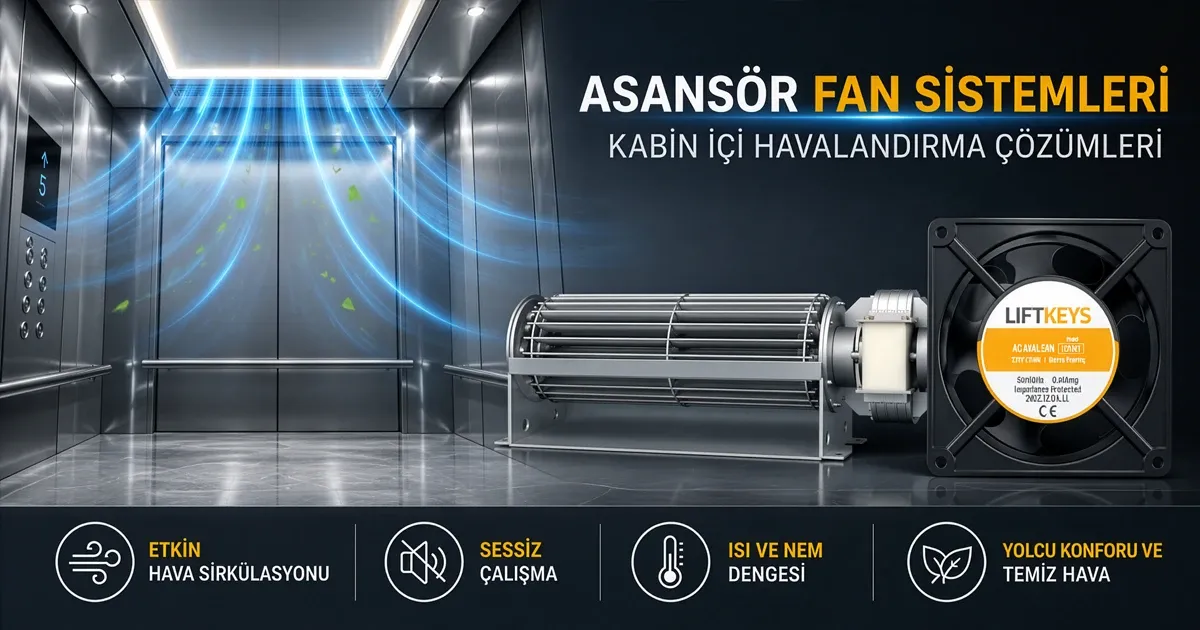
What Are the Types of Fans Used in Elevators? Technical Features and Differences
The volume of elevator cabins, ceiling height, carrying capacity, and building usage density directly affect the required ventilation power. The ventilation needs of a standard 4-person residential elevator and a busy 20-person hospital stretcher elevator cannot be the same. For this reason, in elevator engineering and cabin manufacturing, elevator fan types with different mechanical structures and blowing technologies are preferred to ensure air circulation.
To provide the most accurate air circulation for your cabin, achieve silence, and build a long-lasting system, it is necessary to know the features of these fan types closely. Here are the basic fan types used in modern elevator cabins and their areas of use:
1. Tangential / Cross-Flow Fans
It is today's most popular and standardized fan model in modern passenger elevators.
- How It Works: It has a cylindrical drum structure and numerous thin blades. It sucks air from the side surface of the cylinder at a wide angle and blows it into the cabin in a wide, homogeneous stream.
- Features: Its biggest advantage is that they are ultra-quiet operation and occupy very little vertical space. They are easily hidden behind cabin suspended ceilings. Thanks to the wide blowing outlet, they create a soft and balanced airflow inside the cabin instead of disturbing localized drafts.
- Areas of Use: Residences, business centers, hotels, plazas, and all passenger elevators where aesthetics and silence are at the forefront.
2. Centrifugal / Radial Fans (Snail Fans)
They are industrial type fans used in situations where high air pressure and strong suction/blowing flow rate are required.
- How It Works: It has a curved body structure resembling a snail shell. It takes air from the center (axially), accelerates it, and ejects it outward at a right angle (radially) under very strong pressure.
- Features: The air blowing pressure is very high. However, they operate with more noise than tangential fans and require more vertical space in the cabin ceiling.
- Areas of Use: Stretcher and hospital elevators, heavy-traffic public buildings, freight elevators, and high-capacity elevators where cabin volume is very large.
3. Axial Fans (Propeller Type Fans)
They are traditional propeller structures similar to computer fans.
- How It Works: Airflow occurs on the same axis (parallel) as the fan motor shaft. It takes air from behind and blows it forward.
- Features: Its cost is quite low and installation is very practical. However, when they provide high air flow, the humming noise (decibel level) increases, and because they focus the airflow only on a narrow point, they have difficulty creating a homogeneous freshness inside the cabin.
- Areas of Use: Low-budget old elevator modernizations, construction site elevators, and low-capacity service elevators.
The Most Accurate Air for Your Cabin Needs: Liftkeys Fan Systems
Selecting just a random fan in your elevator cabin design and modernization projects leads to long-term complaints of insufficient ventilation or an endless annoying motor hum inside the cabin. Applying the right fan architecture that offers the right air flow rate to the right project is an engineering necessity.
As Liftkeys, we offer a rich product range of Elevator Fan Systems optimized for the volumetric needs of your cabins. All our alternatives are available in stock, from ultra-quiet, high-performance tangential fan models for your residential and premium plazas to high-flow centrifugal (snail) solutions for your hospitals and industrial facilities. With long-lasting motor bearings and balanced blade structures, Liftkeys fans bring zero vibration and maximum freshness to your cabins.
Frequently Asked Questions (FAQ)
- Why are tangential fans more preferred in passenger elevators?
Elevator users moving vertically in a narrow space do not want the fan blowing harsh air directly onto their heads (creating a draft). Tangential fans spread and blow air over a wide surface and produce almost no sound while operating, making them the most suitable choice for passenger comfort.
- How is fan capacity (flow rate) calculated according to cabin volume?
In elevator ventilation engineering, the air inside the cabin is required to be completely renewed at least 20 to 30 times per hour. The volume is calculated by multiplying the cabin width, length, and height, and based on this volume, the Liftkeys fan model with the required air flow rate in cubic meters per hour ($m^3/h$) is selected.
- Why is balancing the fan blades important?
If there is even a millimetric weight imbalance (out of balance) in the rotating propeller of the fan, it causes vibration in the cabin ceiling when the fan reaches high speeds. This vibration both spreads an annoying rattling noise inside the cabin and rapidly wears out the bearings of the fan motor, damaging the device. Liftkeys fans are manufactured undergoing precise balance testing in production.
